MuleRun Agent Builder: A New Build Paradigm for the Next Generation of Agents
 Dec 22, 2025 |
  10 minute read |
  Author: Junliang Shu, MuleRun CTO
TL;DR: Today’s agent builders face a familiar tradeoff: workflow tools are easy to start with, but struggle to support complex, high-capability agents. Professional frameworks offer far more power, but their complexity excludes many creators—and neither approach truly closes the loop from building to monetization.
To address this, MuleRun is introducing MuleRun Agent Builder. It productizes an emerging industry paradigm—Base Agent + Skills + Knowledge—and turns it into a natural-language-driven build experience. Creators can construct agents with strong reasoning and rich tool-calling capabilities through conversation, while significantly lowering the entry barrier and raising the ceiling of what an agent can do. More importantly, MuleRun Agent Builder is deeply integrated with MuleRun’s commercialization ecosystem, enabling a one-click path from idea to revenue.
MuleRun Agent Builder is entering its first private preview soon. We invite you to help define how the next generation of Agents is built—and monetized.
The Last-Mile Problem in Building Agents
If you’ve ever abandoned a promising agent idea because n8n couldn’t interact with local software or LangGraph required too much engineering effort, you’ve run into a common problem in today’s agent ecosystem.
For many creators, the hard part isn’t coming up with agent ideas—it’s turning those ideas into products that are runnable, maintainable, and monetizable.
As we close out what many call the “first year of AI Agents” in 2025, we’ve seen rapid evolution over the past three years. The term Agent has gone from non-existent, to chatbots, to copilots, and now to systems capable of perception, planning, memory, and tool use to solve complex tasks.
As a global Agent monetization platform, MuleRun has consistently explored how to help more creators build better agents at lower cost.
Early on, we chose to embrace the existing agent ecosystem. We invested heavily in infrastructure compatibility, supporting low-barrier workflow tools like n8n, Dify, and ComfyUI, as well as code-first frameworks such as LangChain, LangGraph, and ADK. We even support embedding fully deployed standalone apps via iframe.
Beyond infrastructure, we studied the learning curves and capability ceilings of these approaches—creating tutorials, demos, and inviting tool experts into our community.
We also provided everything frameworks don’t: LLM APIs, MCPs, and runtime infrastructure. All with one goal—lower cost, higher-quality Agents.
After more than two months of deep collaboration with the community, we reached an uncomfortable conclusion: existing agent development approaches struggle to meet this goal. From today’s perspective, many frameworks feel outpaced by model evolution.
The reality is:
- Workflow tools are easy to get started with but struggle to build powerful agents.
- Frameworks/SDKs can build powerful agents, but the barrier to entry is too high for creators without an engineering background.
- Almost no single toolset provides a complete, end-to-end loop for “Build → Deploy & Run → List & Monetize → Iterate with Data.”
This dilemma led us to a fundamental question: Do we need a new agent-building paradigm?
The Emergence of a New Agent-Building Paradigm
Over the past six months, we’ve been in constant dialogue with AI practitioners in Bay Area and China, exploring the future of agent development. A consensus has begun to form:
Agent = A Loop Core with autonomous decision-making + Knowledge to guide the core on vertical tasks + Tools necessary for those tasks + Interfaces connecting all parts + Continuous performance optimization
A classic implementation of this consensus is: Claude Agent SDK + Skills + Tools + Programmatic Tool Calling
To put it more intuitively, what many consider a “true agent” is evolving from a “pile of prompts + complex workflows/code” into a new paradigm: Base Agent + Knowledge + Tools + Runtime.
Let’s walk through a concrete example. Imagine it’s late 2025, and I want to build an agent to help U.S. citizens file their taxes:
-
First, I’d choose the Claude Agent SDK as my base agent. It comes with a built-in “System 2 Thinking Loop,” automatically handling complex foundational processes like intent recognition, task planning, action selection, reflection, context management, and error retries. I don’t need to write tons of code or drag-and-drop countless blocks for these basics.
-
Next, I’d write some specs or Markdown files to provide the necessary domain knowledge for tax filing, such as how to handle RSUs/options, declare foreign income, or allocate taxes for cross-state remote work. This is specialized knowledge that current LLMs can’t solve on their own, sourced from personal experience or a professional tax advisor.
-
Then, I’d equip the agent with tools. It might need to read data from an Excel sheet or perform calculations, so an MCP for Excel and coding is necessary. The good news is, you can now bundle these tools and tax knowledge into a Skills Repo. Because you’ve encapsulated them as Skills, your base agent can naturally call upon them. Claude Code’s progressive disclosure capabilities also help save a significant amount of tokens during runtime.
And that’s it—you’ve built version 1.0 of your agent. It can accept multimodal inputs and leverage the rich tax knowledge you’ve provided to skillfully use tools like Excel and complete the tax forms. The development cost could be a fifth or even less than with traditional architectures just six months ago.
Looking ahead, imagine your agent is a huge success. As your user base grows, you’ll want to optimize its efficiency and cost. One option is to use Anthropic’s Programmatic Tool Calling to convert multi-step tool calls into code, reducing token costs and improving performance.
While this example heavily features Anthropic’s ecosystem, this new paradigm isn’t exclusive to them. We see more and more companies investing in this direction, like OpenAI Codex, Gemini CLI, and Azure Agent Service. Our internal experiments confirm that this will become one of the standard ways to build agents next year. However, this consensus is still forming, and the ecosystem is nascent. The paradigm currently exists mainly within the SDKs and internal systems of large tech companies; for a creator to use it, significant engineering background and infrastructure investment are still required. Furthermore, we haven’t seen a friendly, community-driven solution like n8n or LangGraph that can plug into MuleRun’s commercial ecosystem.
So, this time, we decided to build it ourselves. We are proud to introduce our brand-new agent-building tool: MuleRun Agent Builder.
MuleRun Agent Builder is more than just an implementation of this new paradigm. It’s a completely new building experience designed for ease of use, creator-friendliness, and tight integration with MuleRun’s commercial ecosystem. In other words, we want to take the Base Agent + Knowledge + Tools + Runtime paradigm and turn it into a builder that any creator can master and use to launch a monetizable product with one click.
MuleRun Agent Builder: Making the New Paradigm Accessible and Monetizable
We believe a truly great building tool must deliver value to creators on several fronts simultaneously: the building experience must be radically simple, the capability ceiling of the output must be high, the operational burden must be near-zero, and the commercial loop must be seamless. MuleRun Agent Builder is built around these design philosophies and offers the following core capabilities.
State-of-the-Art Agent Building, Driven by Natural Language
Historically, there have been two typical ways to build agents: low-barrier, low-ceiling workflow tools like n8n and Dify, and high-barrier, high-ceiling programming frameworks like LangGraph and ADK.
The new paradigm offers a new possibility: building a high-ceiling agent capable of complex actions like browser interaction and advanced tool calling, all with a near-zero code approach. It strikes a new balance between accessibility and power.
But for MuleRun, that’s not enough. Our founding vision is to expand the community of agent creators to include domain experts without technical skills. For a tax consultant, even if no coding is required, understanding and correctly selecting the right Base Agent, Skills, and MCPs is still a high bar (e.g., how do you pick the right tax skill from 30,901 options on a skills marketplace?).
Therefore, our goal with MuleRun Agent Builder is to abstract away these technical details. We’re providing a fully natural language-driven path to agent creation. The MuleRun Agent Builder will interview you in a multi-turn conversation about what you want to achieve, guiding you step-by-step through the process. You don’t need to worry about the technical nitty-gritty; just focus on the job you want the agent to do, training it like you would a new employee.
From a creator’s perspective, this means:
-
The onboarding path is a conversation with a Builder agent, not learning a complex framework—the floor is low.
-
The underlying Base Agent + Knowledge + Tools + Runtime paradigm natively supports planning, reasoning, and tool use—the ceiling is high.
A Fully-Managed, All-in-One Cloud Experience for Building, Testing, and Iterating
Even as new technologies simplify the process, an AI agent remains a more complex application than a traditional website or software. It relies on a diverse set of LLM APIs, stable sandbox environments, and a rich supply of tools.
Unlike simple workflow tools, we rarely see complex agent frameworks like LangGraph or ADK offering a fully-managed runtime environment. Creators often have to develop and debug locally, then re-integrate all the infrastructure resources in a cloud environment just to make their agent accessible to others.
Over the past three months, MuleRun has built a comprehensive cloud runtime that supports a wide variety of heterogeneous agents, enabling fully automated global distribution and access. We also provide creators with one-stop access to LLM APIs and MCPs.
MuleRun Agent Builder will be integrated with these capabilities from day one. Creators will get a pure cloud-based experience for building, testing, and iterating—no local compute resources needed, no hunting for and purchasing various APIs. You can complete the entire development loop for the new paradigm right within MuleRun.
Seamless Integration with the MuleRun Commercial Ecosystem for One-Click Monetization
The biggest difference between MuleRun and other agent platforms is our focus on commercialization. Building an agent is just the beginning. Our ultimate goal is to incentivize more people to use their domain knowledge to create unique agents and earn rewards. This market-driven, virtuous cycle of “build → monetize → reinvest” is the core engine of MuleRun’s ecosystem.
Therefore, MuleRun Agent Builder will be plugged into MuleRun’s existing global distribution and monetization network from day one. The agents you create can be commercially validated immediately. You can get a head start before the new paradigm becomes mainstream, gathering real market feedback from actual users and iterating on your product until it generates a steady stream of revenue. In the AI era, a head start is everything.
Become One of the First Co-Builders of the New Paradigm
The image generation agent below was built in 10 minutes using MuleRun Agent Builder. But this is just a simple example. What we care about most are the agents you want to build—the ones that are currently blocked by today’s tools.
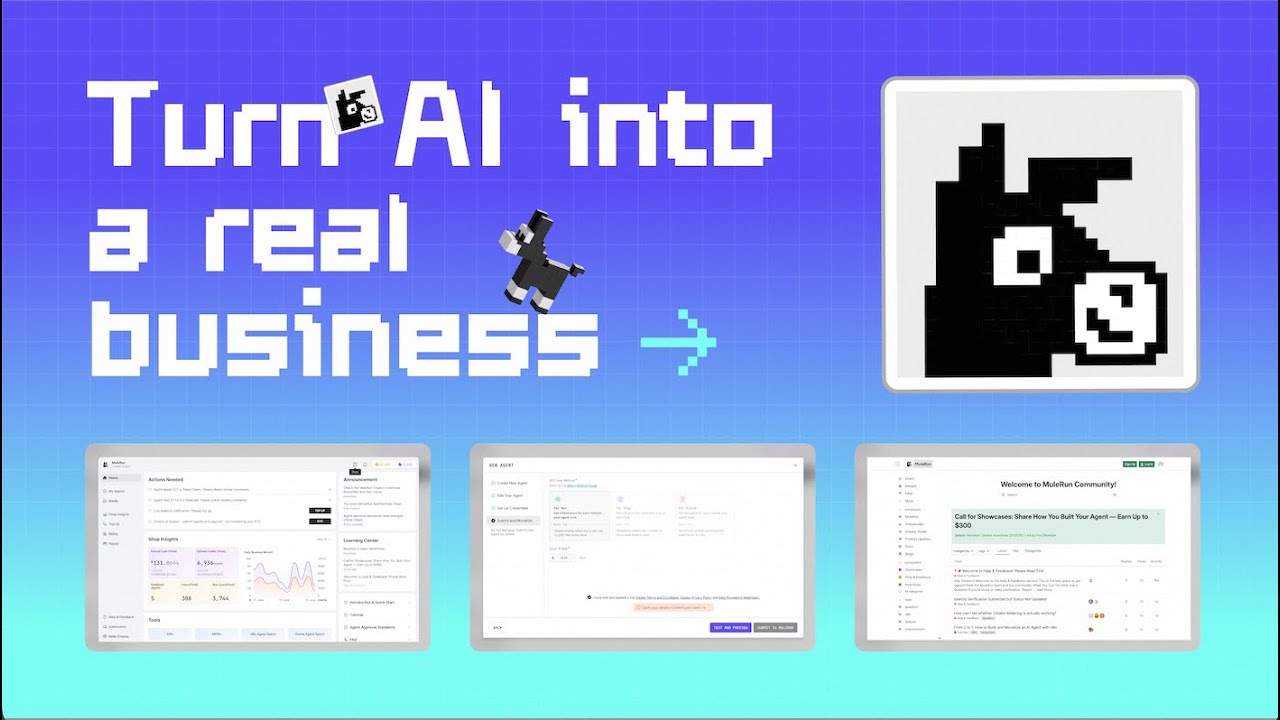
If you have an agent idea but can’t find the right tool, or if you’re using an existing framework but find the process of launching, monetizing, and iterating to be clunky, we invite you to join us. Let’s work together to turn the next-gen agent-building paradigm into a MuleRun Agent Builder that truly helps you make money. We’ve started a discussion thread in the MuleRun Community and would love to hear your thoughts on:
-
What kind of agents are truly worth paying for?
-
What Skills or capabilities are needed to build them?
-
If you were to use MuleRun Agent Builder, what features would you need?
MuleRun Agent Builder is currently in a private internal preview. We plan to begin the first wave of early access invitations on January 15, 2026. High-quality, thoughtful responses will be prioritized for the first batch of invites.
We invite you to join us in shaping the early ecosystem of this new agent paradigm in real-world use cases and become one of its first co‑builders!
