The digital world is currently drowning in a sea of “AI-sounding” content. We have all experienced that moment of frustration when we ask a standard AI to write a video script, only to receive a formal, robotic draft filled with clichés like “In today’s digital landscape” or “Unleash your potential.” In the fast-paced world of TikTok, Reels, and YouTube Shorts, these scripts are a recipe for failure. Viewers scroll past within two seconds if they sense a lack of authenticity. I built the Viral Script Humanizer (VSH) specifically to solve this “Drone Factor,” transforming sterile AI drafts into high-retention, punchy scripts that sound like a real human talking to a friend.
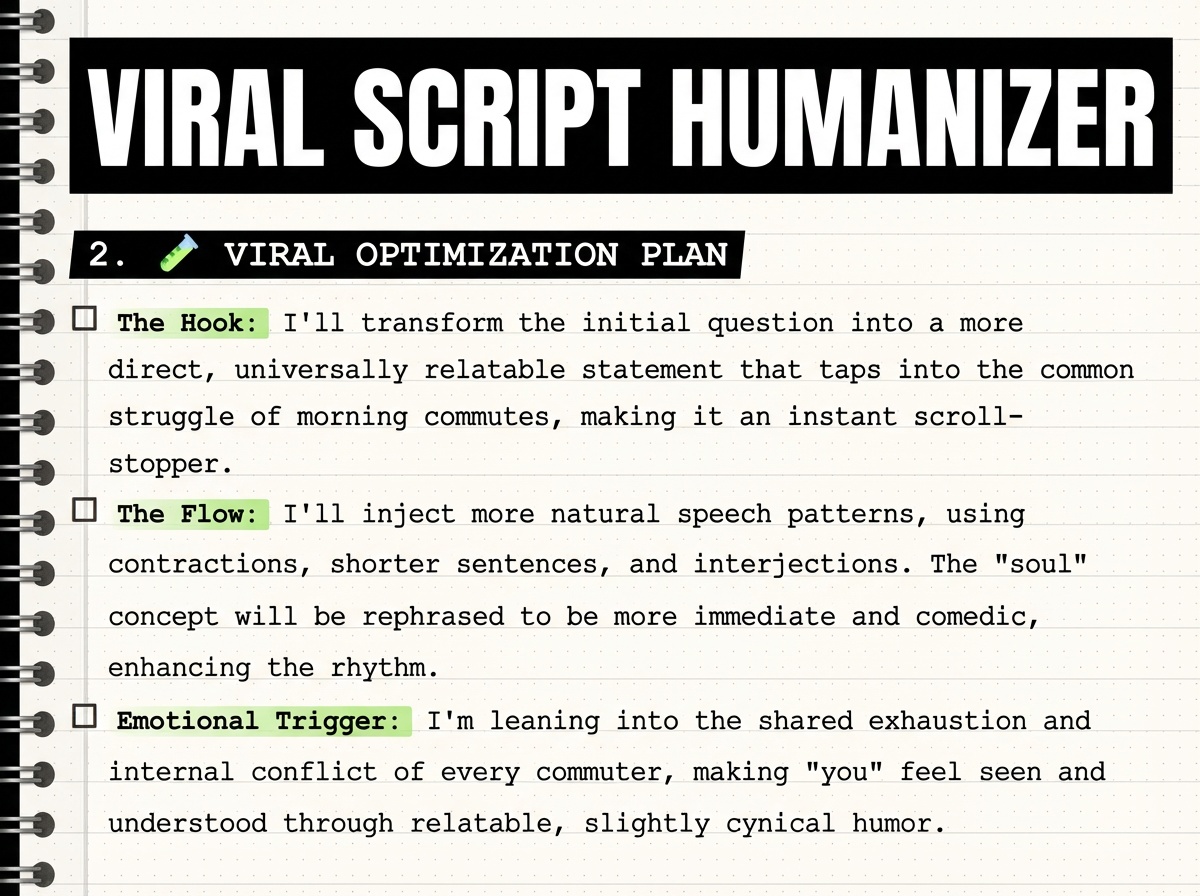
The core philosophy behind this agent is “Writing for the Ear, Not the Eye.” Most AI models are trained on written text, which is inherently different from spoken dialogue. To fix this, I engineered a specialized prompt protocol that forces the agent to use “The Bar Test”—if you wouldn’t say a sentence to a friend at a loud bar, the agent deletes it. It prioritizes sentence fragments, contractions, and immediate “Scroll-Stoppers” over formal grammar. By focusing on the first three seconds of a video, the agent ensures that the hook is either a bold statement or a visual conflict, which is the secret sauce to winning the current attention economy.
From a technical perspective, I chose n8n as the backbone for this agent because it allowed me to create a sophisticated data pipeline that goes far beyond a simple chat interface. The intelligence layer of the operation is powered by an advanced fine-tuned Large Language Model. Unlike generic models, this LLM has been specifically optimized through meticulous prompt engineering and behavioral constraints to recognize the nuances of human speech. It is trained to prioritize spoken cadence, strip away formal filler, and inject “burstiness”—the rhythmic variation between short, punchy statements and descriptive explanations that keeps an audience engaged.
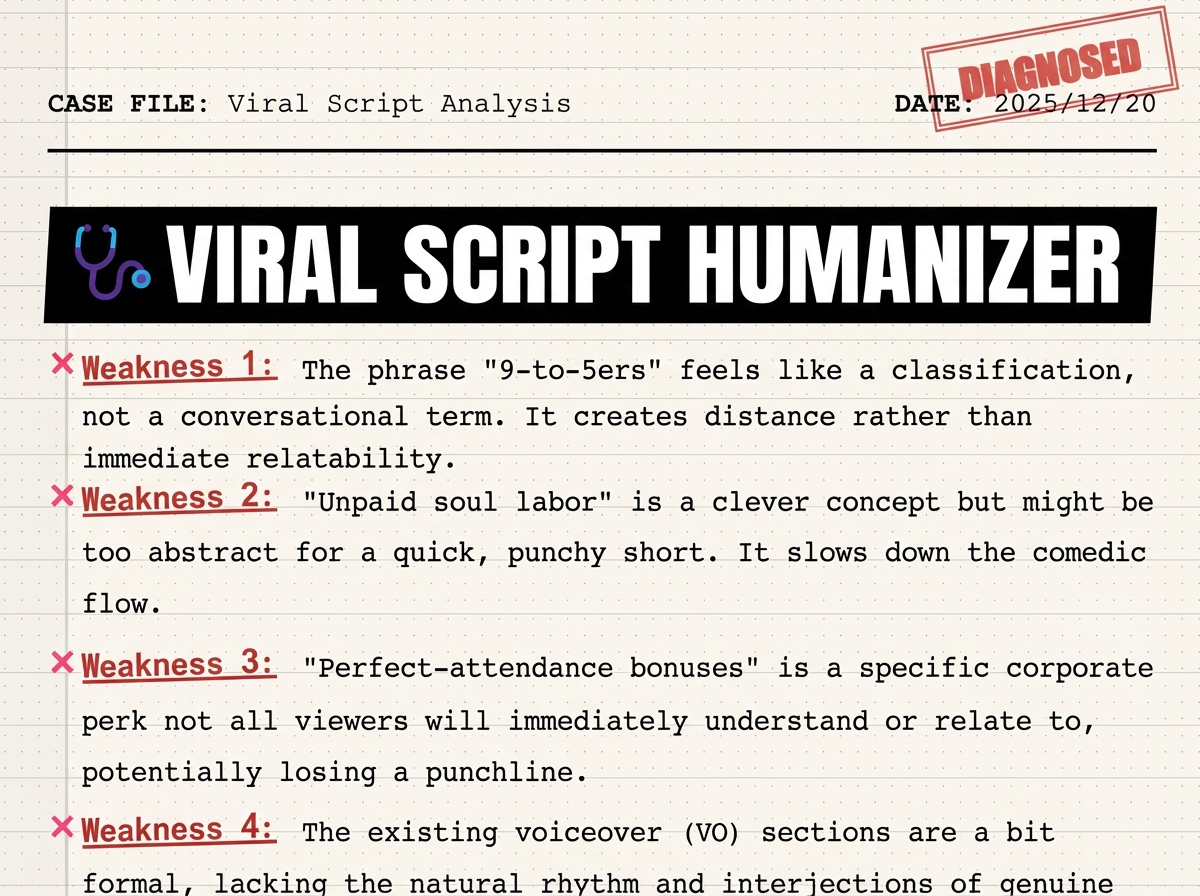
The workflow begins with a user-friendly Form Trigger where creators paste their rough drafts and select their desired output format. The advanced LLM then performs a deep analysis, starting with a “Roast” of the original text to identify exactly why it would fail in a viral context. One of the most unique features of the Viral Script Humanizer is how it handles post-processing through a custom JavaScript node. I realized early on that relying solely on AI for formatting can lead to inconsistent results. To solve this, I developed a “Format Data Processor” that takes the raw intelligence from the LLM and wraps it in beautiful, functional designs.
Depending on the user’s choice, the workflow generates a “Web Version” styled as a retro detective’s case file—complete with highlighter effects and red-pen corrections—or a “Document Version” which is a clean, professional table ready for production teams. This ensures that the creator gets more than just text; they get a production-ready roadmap. During development, the biggest challenge was avoiding “cringe” slang. By implementing a “De-AI Specialist” layer within the pipeline, the agent specifically hunts for and eliminates “AI Bingo Words” like Tapestry, Realm, and Foster, ensuring the final script feels naturally energetic without being artificial.
The result is a tool that saves creators hours of editing time and significantly increases their chances of retention. By providing a script that includes specific visual cues and audio pacing, the Viral Script Humanizer bridges the gap between a writer’s room and a film set. It empowers creators who might have great ideas but struggle with the “blank page” or the formal tendencies of standard AI models. Building this on MuleRun has allowed me to turn a complex humanization strategy into a streamlined, one-click solution that anyone can use to level up their content game.
I invite you to try the Viral Script Humanizer and see the difference for yourself. Stop letting robotic AI drafts kill your engagement. Let’s make content that actually connects with real people. I am excited to continue evolving this agent, with future plans to integrate direct audio previews to help creators hear their humanized voice before they ever hit record.